We Asked 3 AIs the Same Hard Question. Then We Made Them Fight About It.
We ran a live 3-round debate on DeepThnkr — Gemini 3 Flash, Gemini 2.5 Pro, and GPT-5 arguing microservices vs monolith. Here's exactly what happened, round by round.
The question every new SaaS founder gets wrong at some point: microservices or monolith?
It's one of those decisions that feels like it has an obvious answer — until you've talked to someone who built the wrong one. So we ran it through DeepThnkr's Debate Mode: three AI models, three rounds of structured argument, one synthesized verdict.
Here's exactly what happened.
The Setup: Three Models, One Controversial Question
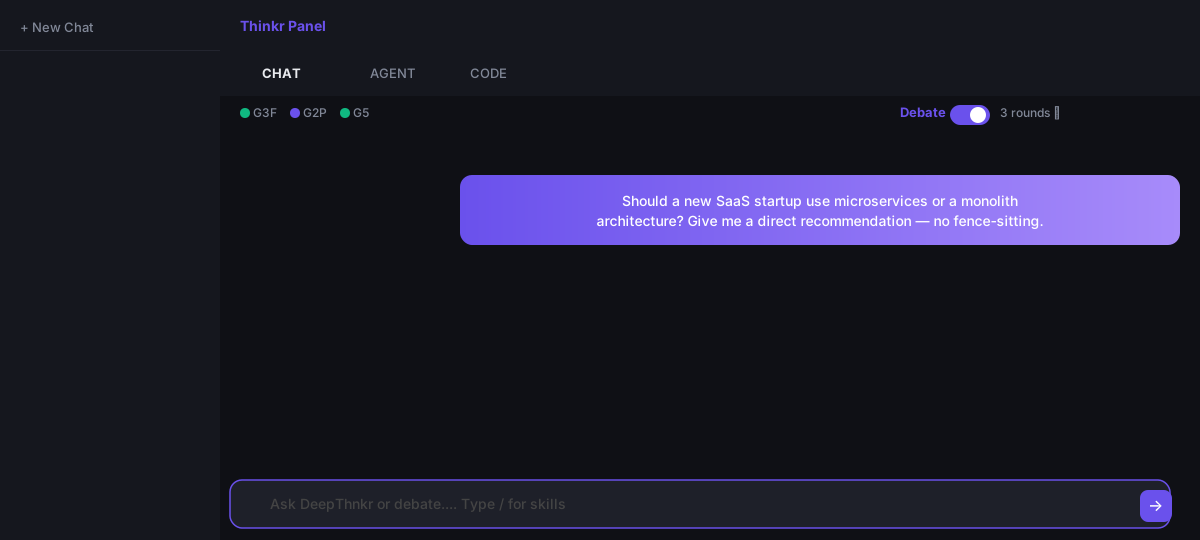
DeepThnkr's Council Chat lets you select which AI models participate in a debate. We ran this with three active in April 2026:
- Gemini 3 Flash — labeled "Concise & actionable"
- Gemini 2.5 Pro — labeled "Thorough & structured"
- GPT-5 — labeled "Creative & nuanced"
Debate Mode was enabled with 3 rounds. The question we typed:
"Should a new SaaS startup use microservices or a monolith architecture? Give me a direct recommendation with specific trade-offs — no fence-sitting."
The "no fence-sitting" prompt matters. Without it, AI models will hand you a mealy-mouthed "it depends" non-answer and call it balanced. We wanted positions.
Round 1: Opening Arguments
Each model answered independently, without seeing the others' responses first. That's critical — if they see each other first, they anchor to the first answer and the debate collapses.
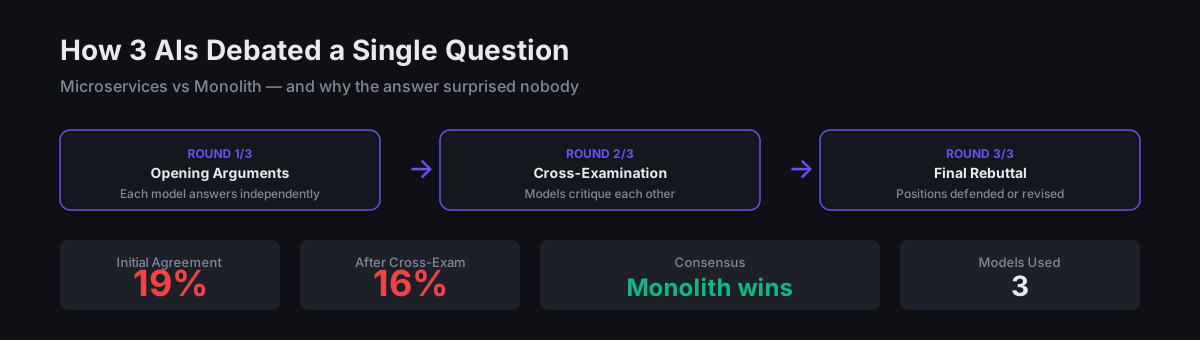
The agreement meter appeared immediately: 19%.
Three separate AI models, all trained differently, looked at the same question and agreed on 19% of it. That number is exactly what makes DeepThnkr useful — it makes visible just how much disagreement exists even when the models technically reach similar conclusions.
Gemini 3 Flash: Direct and blunt. "For a new SaaS startup, the correct choice is a Monolith. Choosing microservices prematurely is technical debt masquerading as 'scalability.' In the early stages of a startup, your primary risk is not a lack of scalability; it is a lack of product-market fit and speed of iteration."
Gemini 2.5 Pro: Framed it as survival math. "My direct recommendation is to begin with a well-structured monolith. Do not start with microservices. This is not a matter of technical preference; it is a matter of business survival. A startup's primary battle is against obscurity and irrelevance, not technical debt or scaling limitations."
GPT-5: Gave the most granular breakdown. "Recommendation: Start with a modular monolith. Do not adopt microservices at inception." Then listed five specific reasons: speed to PMF, lower cognitive load, simpler data model, cheaper to debug, and cleaner governance for SOC 2.
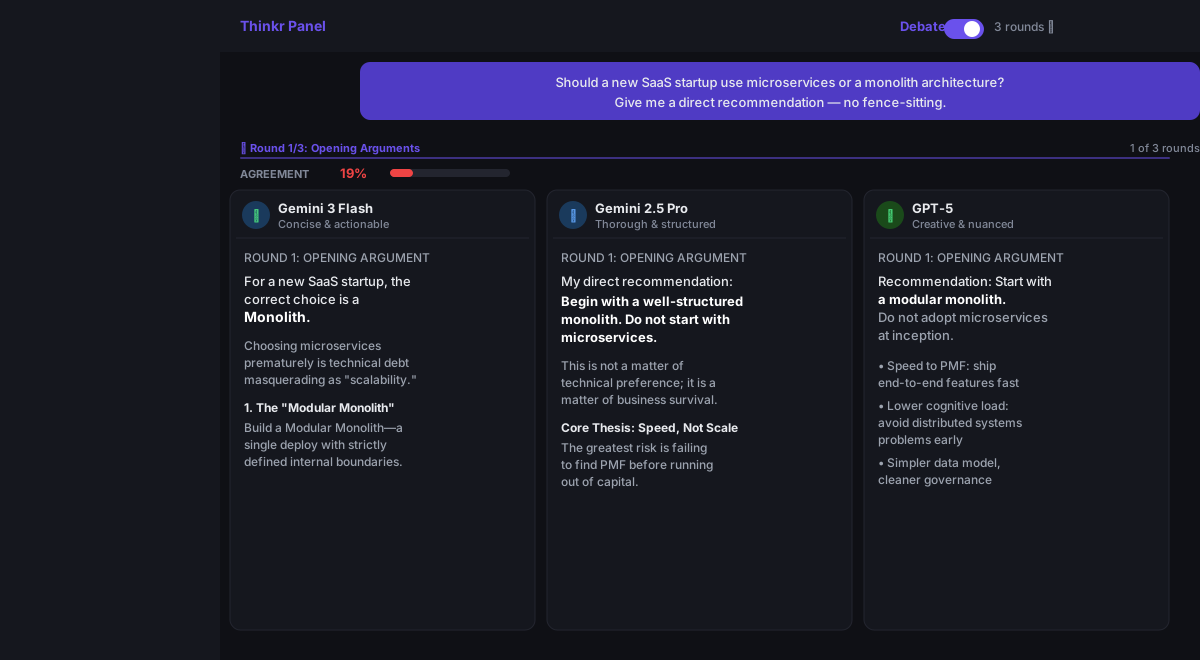
All three said monolith. So where's the 19% agreement coming from?
The disagreement was in the reasoning. Gemini 3 Flash emphasized iteration velocity. Gemini 2.5 Pro emphasized PMF risk. GPT-5 emphasized operational overhead. They gave different whys for the same what, and those different why's would lead to different decisions if the context shifted — say, a startup with a 10-person engineering team versus a solo founder, or one building for regulated industries versus consumer apps.
The disagreement in reasoning is exactly the kind of information that single-model AI buries. One model says "use a monolith" and you take it. Three models say "use a monolith" for different reasons, and you understand the actual decision space.
Round 2: Cross-Examination
The models were shown each other's opening arguments and asked to critique them. This is where it got interesting.
The agreement score dropped from 19% to 16% — the models became less aligned as they dug into each other's reasoning. That's a counterintuitive result that reveals something real: surface-level consensus hides substantive disagreement.
Gemini 2.5 Pro challenged Gemini 3 Flash's "Modular Monolith" framing: the monolith has to be designed for eventual decomposition from day one, or the "modular" qualifier is wishful thinking. A true spaghetti monolith — the kind most founders actually build when they're moving fast — is harder to break apart than greenfield microservices.
GPT-5 pushed back on the operational load argument: modern infrastructure (Railway, Render, Fly.io) has largely eliminated the DevOps overhead that made microservices so expensive at small scale in 2018. The argument that microservices require a platform team no longer holds at 2026 tooling prices.
This is the cross-examination round doing its job — surfacing the hidden assumptions inside the initial recommendations.
Round 3: Final Rebuttal
Each model got a final chance to hold or revise its position after seeing the cross-examination critiques.
Agreement after Round 3: 16%. The positions hardened rather than converging.
Gemini 3 Flash held its Modular Monolith recommendation but sharpened the reasoning: the modularity has to be enforced architecturally from day one (bounded contexts, clear service interfaces), not added later. The "we'll clean it up when we scale" monolith is how you end up with a worse outcome than microservices would have given you.
Gemini 2.5 Pro doubled down on the business-speed argument, pushing back on GPT-5's infrastructure point: even if the deployment overhead is lower, the cognitive overhead of building distributed-first — designing for network partitions, idempotency, eventual consistency — from day one is a genuine productivity tax on a team trying to find PMF.
GPT-5 held its nuanced position and specifically argued that the real answer depends on team size and domain: a 1–3 person team should start monolith, full stop. A team of 8+ with prior microservices experience and a domain that genuinely maps to bounded services (e.g., a marketplace with distinct buyer/seller/payment contexts) might reasonably start modular from day one.
What the Debate Gave Us That a Single Answer Couldn't
Ask ChatGPT "microservices or monolith?" and you'll get a version of "monolith first, microservices later, it depends." That's technically correct and practically useless.
The DeepThnkr debate gave us:
- Three different frameworks for the same decision — velocity vs. survival math vs. operational overhead — each of which highlights different risks.
- The conditions under which the consensus breaks — GPT-5's carve-out for experienced teams with domain-mapped boundaries is a genuine exception the other models didn't surface.
- The hidden assumption in every recommendation — Gemini 3 Flash's "modular monolith" only works if you build modularity in from the start, which most people don't.
- A 16% agreement score — a signal that this is a genuinely contested question, not a settled one, which changes how confidently you should act on any single model's advice.
That's the actual value of the debate framework: not a better answer, but a more honest representation of the answer space.
Try It Yourself
The question we ran is one of the most-discussed architecture decisions in startup engineering. But the format — three models, three rounds, explicit agreement scoring — works for any high-stakes question where you suspect a single model will give you a confident, incomplete answer.
Strategic decisions. Technical architecture. Hiring calls. Market analysis. Anything where "it depends" is the real answer but you need to understand what it depends on.
DeepThnkr is live at deepthnkr.com with a 7-day Pro trial. The Council and Debate modes we walked through above are both available from day one — no setup, no API keys required.
Stop guessing which AI is right.
DeepThnkr runs your question through GPT-5, Claude, Gemini, and DeepSeek simultaneously — then makes them debate and synthesizes a validated answer. 30% fewer hallucinations. One subscription.
Try DeepThnkr free — 7-day Pro trial →